





 52 reasons
  Free PDF


 Message us on WhatsApp
  Book a Free Call

 Climbing
 This year, we decided to publish our safety statistics and a full account of the incidents that occurred on Kilimanjaro in 2025. Our main reason is straightforward: we want to show, in numbers, how safe it was to climb Kilimanjaro with Altezza Travel.
In this report, you’ll find:
- Total Kilimanjaro climbs in 2025
- The number of expeditions Altezza Travel ran
- Our summit success rate, including how many climbers in our groups didn’t reach the top, and why
- The major incidents that took place on Kilimanjaro in 2025
We hope this data helps you assess what climbing with us would realistically look like for you. At Altezza Travel, we believe trust is built on honesty and transparency.
How We Gather Our Data
Altezza Travel Expeditions
Altezza Travel is the largest Kilimanjaro operator. In 2025, we guided 4,371 climbers from around the world, a scale we believe makes our data representative of the industry as a whole.
57% of our climbers were men, 43% women. Most came from the United States, Germany, the United Kingdom, and Canada.
We collect detailed expedition data through a proprietary system built by our in-house IT team that logs everything: the number of participants per expedition, dietary preferences, fitness levels, health conditions, route choices, prior high-altitude experience, and dozens of other variables. We track evacuations, illnesses, and every incident in our expeditions the same way.
Incidents at Other Operators and Industry-Wide Trends
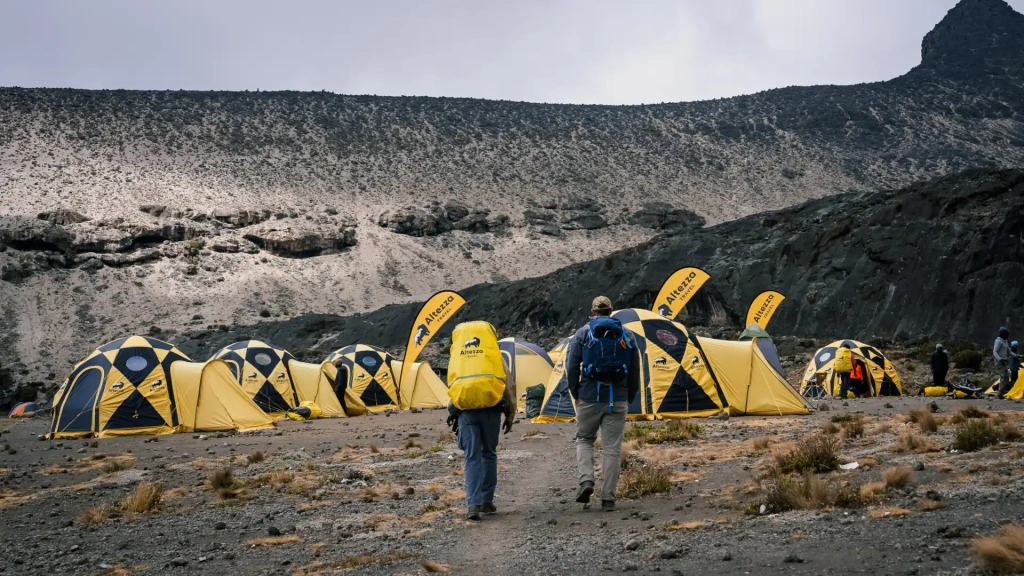
We’re typically among the first to learn about incidents involving other operators, because on any given day, at least one Altezza Travel expedition is camped somewhere on the mountain. When something happens, our guides hear about it from park rangers or guides from other companies, and when help is needed, our teams assist with evacuations for clients and porters from other operators.
We also receive information through our membership in the Tanzania Association of Tour Operators (TATO) and from official publications by Kilimanjaro National Park Authority and Tanzania’s Ministry of Natural Resources and Tourism.
Kilimanjaro Climbs in 2025
How Many People Climbed Kilimanjaro in 2025
According to the Tanzania Ministry of Tourism bulletin, 58,782 people visited Kilimanjaro National Park in 2024. Not all of them attempted the summit – roughly 20% come for day hikes, short one- or two-day walks that don’t go all the way up.
Confirmed 2025 figures won’t be available until the end of 2026, and we’ll update this report when they are. Based on the growth trend from 2022 to 2024, we estimate that around 63,000 people visited the park in 2025, with approximately 44,000 attempting the summit.
Summit Success
Of the 4,371 climbers in Altezza Travel expeditions in 2025, 3,892 reached Uhuru Peak – the summit of Kilimanjaro at 5,895 m (19,341 ft).
Another 215 reached one of the key points on the crater rim: Stella Point (5,739 m / 18,829 ft) or Gilman’s Point (5,681 m / 18,638 ft). Both sit on the rim of the crater, and they are, in effect, the summit itself. The walk from either point to Uhuru Peak takes about an hour, and we count arrivals at any of the three as a successful summit.
If you want a rough sense of your personal summit odds, try our summit probability calculator, built from data on 25,000 Altezza Travel climbers.
Climbers Who Didn’t Summit
In 2025, 264 climbers in our expeditions did not reach the summit. There were three main reasons:
Insufficient acclimatization. Some climbers couldn’t acclimatize and had to turn back. This happens on any high-altitude expedition – how well your body adjusts depends not only on how long you spend at altitude, your fitness level, nutrition, sleep, and gear, but also on factors that are simply impossible to predict in advance: how your flight went, stress levels, and individual physiology. Sometimes, experienced mountaineers who have climbed harder peaks struggle with acclimatization on Kilimanjaro, while complete beginners reach the summit without difficulty.
Fatigue. Some climbers ran out of steam – either on the summit push itself or on the way up to high camp – and chose not to continue. The decision to push for the summit is always the climber’s own. If a lead guide can see that someone simply doesn’t want to go on, we never pressure them.
Staying with a companion. Many people climb with a partner or a group of friends. When one person has to turn back due to acclimatization issues or fatigue, their companions sometimes choose to descend with them rather than continue alone. In 2025, 52 people made that call – under other circumstances, they could have gone all the way.
Evacuations on Kilimanjaro in 2025
Standard Evacuations
It’s worth noting upfront: an evacuation doesn’t mean there was a serious threat to someone’s life. We use the word to describe any early descent – whether due to poor acclimatization, fatigue, or general illness.
In most cases, the climber simply walks down to the park gate with a guide or assistant guide, then goes back to the hotel to rest. No medical evaluation is needed.
In 2025, Altezza Travel conducted 90 evacuations of this type.
Helicopter Evacuations
Sometimes altitude sickness can escalate rapidly, and a climber may show signs of high-altitude cerebral or pulmonary edema [fluid buildup in the brain or lungs]. In those cases, oxygen and medication can buy time, but they’re not a substitute for hospital care. The faster you get someone to lower altitude and to a doctor, the lower the risk of lasting harm. That’s when we call in a helicopter.
In 2025, Altezza Travel carried out 64 helicopter evacuations. All were successful.
The Most Difficult Evacuation in Altezza Travel History
In May 2025, we conducted what turned out to be the most difficult evacuation in our company’s history.
One of our clients ( we’ll call him Bill*) had undergone a double lung transplant in 2016. He was in good physical condition, and his medical clearance indicated that the transplant was not a contraindication for climbing Kilimanjaro.
Early one morning, at a stop in Barranco Camp at 3,950 m (12,959 ft), Bill complained of chest pressure and difficulty breathing. The guides checked his blood oxygen level – 92%, within normal range. His pulse and other vital signs were also acceptable, but he continued to deteriorate.
Calling in a helicopter evacuation wasn’t an option: that day, the Tanzania Civil Aviation Authority had announced an audit and grounded all flights in the country. The team immediately put Bill on oxygen and began descending the Umbwe Route – the shortest way out of the park. The trail is too steep and narrow for a stretcher, but Bill’s condition at the start of the descent allowed him to walk.
In heavy rain season, though, the trail had washed out badly. The team moved much slower than normal, and Bill’s condition kept worsening despite the oxygen. The team burned through six oxygen cylinders over 16 hours of descent – a situation that had no precedent in Altezza Travel’s history, or anyone else’s.
By the time they reached the park gate, Bill was still conscious and aware of what was happening, but he had become noticeably sluggish. His breathing had deepened and quickened, and his responses were short, one-word answers.
Around 2 a.m., the team reached the gate. Bill was taken to KCMC Hospital [Kilimanjaro Christian Medical Centre] in Moshi. Dmitry, our expeditions director, had been on the phone with the hospital throughout the descent, flagging the severity of the case in advance. Because of that call, the head of emergency medicine, a cardiologist, and other specialists were on-site when Bill arrived – staff who normally wouldn’t be in the hospital in the middle of the night.
On arrival, it became clear that despite the descent to lower altitude, Bill’s condition wasn’t improving. Doctors worked to stabilize him, but without success. By morning, the team decided to arrange an air transfer to Aga Khan Hospital in Nairobi, which has the best diagnostic and treatment capabilities in East Africa.
The situation was further complicated by conditions at KCMC itself: the hospital was overwhelmed, and the ICU had been temporarily relocated to another wing. While the flight was being coordinated, Bill deteriorated sharply. He became confused and agitated, lost control of his actions, and kept trying to pull off his oxygen mask and disconnect his IV. What was happening was a convergence of multiple crises – oxygen deprivation, toxin buildup from kidney failure, and a severe acid-base imbalance – each of which can independently impair brain function; together, they produced a severe encephalopathy.
The underlying cause was a cascade of complications tied to the bilateral lung transplant. Transplanted lungs lose their connection to the nervous system, which means the cough reflex below the anastomosis (the point where donor and recipient airways are joined) disappears, and the bronchi can no longer clear mucus naturally. Add to that the continuous use of immunosuppressants to prevent organ rejection, and you have a setup for infection: with impaired immune function and impaired airway drainage, pneumonia took hold. The altitude didn’t cause the infection, but it dramatically narrowed Bill’s margin – his transplanted lungs already had reduced diffusion capacity, and at altitude, his body simply couldn’t extract enough oxygen. He developed mixed pulmonary edema, partly altitude-induced, partly inflammatory, following a pattern similar to acute respiratory distress syndrome (ARDS), and even supplemental oxygen was no longer enough.
At the same time, his kidneys stopped filtering waste products, and metabolic acids began building up in the blood. Oxygen deprivation added lactic acidosis on top: cells deprived of oxygen switch to anaerobic energy production and release lactic acid as a byproduct. His pre-existing diabetes, common in transplant patients on long-term steroids, compounded everything: under the stress of infection and physiological crisis, blood sugar regulation collapsed, the body shifted to burning fat, and ketone bodies accumulated, producing diabetic ketoacidosis and another layer of acid-base disturbance. The only way to break the cycle was dialysis, but the equipment at KCMC was down that day. There was no way to slow the cascade, and Bill continued to deteriorate rapidly.
Working with the head of emergency medicine and other specialists, the team assessed whether transferring Bill by air in that condition was safe. A medical flight with someone in that state – with transplanted lungs – carried serious risks, and a ground transfer to Nairobi would take far too long.
At 4:00 p.m., the doctors decided to put Bill in a medically induced coma and place him on a ventilator. That required consent from his next of kin. We reached his wife, who agreed. This was an unusual and high-stakes situation for KCMC, and every available specialist was brought in to prepare. A portable ventilator was readied for transport. The intubation went smoothly. An ambulance took Bill to Kilimanjaro International Airport, where he was met by an AMREF Flying Doctors (a leading East African air ambulance service) aircraft. Accompanied by doctors and two Altezza Travel staff members, he flew to Nairobi.
Additional Altezza Travel staff drove to Nairobi separately. There, we maintained a continuous presence outside Bill’s room and stayed in constant contact with his family.
Forty-eight hours later, the doctors began bringing Bill out of the coma. It was a tense moment: he couldn’t breathe on his own and remained unconscious; the first attempt to wean him off the ventilator failed. But on the third day, Bill began breathing independently, and consciousness gradually returned.
First came reactions, then speech, then improving motor control – he started walking and eating on his own. Two weeks later, he had fully recovered. Bill was discharged and flew home to his wife and children.
This case illustrates how quickly a combination of adverse factors can become life-threatening – a grounded helicopter, a washed-out trail, an overwhelmed hospital, a broken dialysis machine. But it also shows what’s possible when the response is right: timely oxygen support throughout the descent, the call to transfer to Nairobi, and a team that operated as a cohesive unit at every stage.
The doctors in Nairobi told us afterward that without continuous oxygen during the full 16-hour descent from Kilimanjaro, Bill would not have survived. By that point, his kidneys were already failing, and at insufficient blood oxygen levels, irreversible organ damage can develop within hours. The washed-out trail and slow pace meant a longer descent than anyone planned for, and the first team’s oxygen supply was sized for a standard 6-to-8-hour evacuation. The spontaneous decision to send a second team up the mountain with additional tanks turned out to be the single most critical call of the entire evacuation.
*The client’s real name has been changed for privacy reasons.
Porter and Crew Evacuations
Unlike the Sherpas of Nepal, who are born and raised at high altitude and develop a lifelong physiological adaptation to it, Kilimanjaro guides and porters have no genetic acclimatization advantage. They’re just as susceptible to altitude sickness as any climber, and twice a year, at the start of each climbing season, they have to re-acclimatize from scratch.
Like clients, guides and porters sometimes get sick mid-expedition. Every crew member goes through a pre-expedition medical check, and if there’s any doubt about their condition, they’re pulled from the trip. That said, illnesses like the flu don’t show symptoms on day one, so some cases are impossible to screen out. If a crew member gets sick on the mountain, they descend – same as anyone else.
In 2025, we conducted 4 helicopter evacuations for crew members, and 12 more were evacuated by stretcher. Over 80 other crew members descended on foot, accompanied by colleagues.
Our care on the mountain doesn’t stop at our own teams. Altezza Travel helps anyone on Kilimanjaro who needs it. When our guides encounter a porter or climber who appears to need urgent help, we assist where possible and help coordinate descent or medical attention. When we come across poorly equipped or struggling porters on the trail, we make sure they get down safely and receive medical attention if needed. In 2025, this happened 25 times.
One of such episodes was featured in a video by out traveller Chris Balladeres.
How to Verify Your Climb Will Be Safe for the Crew
One way to check whether an operator follows recognized porter welfare standards is to verify whether it is part of the KPAP program, which monitors standards set by IMEC. KPAP is an association of operators that have committed to meeting the standards set by the International Mountain Explorers Connection (IMEC). Those standards set minimum wages and safe working conditions – in practical terms, the operator must provide the crew with three hot meals a day, adequate gear, and evacuation and medical care if anyone gets sick.
KPAP’s compliance is monitored by independent inspectors who join expeditions and file reports with both the operator and KPAP’s office after each climb. Violations trigger a warning; repeated violations may result in removal from the association.
In 2025, Altezza Travel received no violations from KPAP inspectors and
continued to pay one of the highest wages in the industry. As an active B Corp and Travelife Partner in Tanzania, we’ll continue raising the bar for safe climbing in 2026.
The current member list is available on the IMEC website, and you can learn more about how the program works in our guide to KPAP.
Helicopter Crash – December 2025
In December 2025, just before Christmas, a rescue helicopter operated by KilimedAir crashed on Kilimanjaro. The aircraft was carrying two clients from a local operator (both Czech nationals), a mountain guide, a paramedic, and the pilot. All five were killed. Altezza Travel established a scholarship to cover the education of the paramedic’s children – someone we had worked with personally on many previous flights. This was the first crash of its kind in many years; the cause is still under investigation.
Rescue and other flights on Kilimanjaro have since resumed as normal.
How We Keep Climbs Safe
Summit ambition never comes before safety. If a climber is experiencing serious acclimatization problems, Altezza Travel guides will always call the climb. Kilimanjaro is considered relatively accessible compared to other major peaks, but severe altitude sickness can have permanent consequences. In 2023, a Dutch student climbing with a local operator developed cerebral edema (dangerous fluid buildup in the brain) and was left with lasting neurological damage. That same year, a climber from Singapore died on Kilimanjaro from altitude sickness.
Our guides take every symptom seriously, even mild ones – altitude sickness can escalate fast, and catching it early makes the difference between a safe descent and a medical emergency.
That said, our guides also understand how much reaching Uhuru Peak matters to the people they’re guiding. In early-stage cases, we’re usually able to manage with bottled oxygen and extra rest, allowing the acclimatization process to get back on track and the expedition to continue.
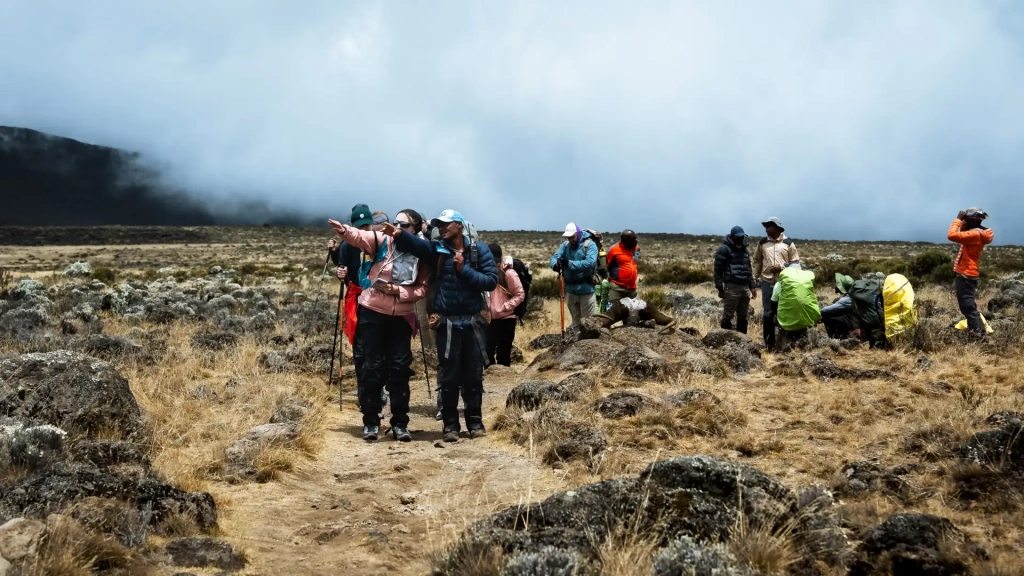
Routes designed for real acclimatization. Altezza Travel runs 7- and 8-day itineraries. These timeframes work equally well for first-time altitude climbers and for experienced mountaineers returning after a break.
Twice-daily health checks. Every morning and evening, we conduct medical check-ins for all climbers and crew. These check-ins are often where we catch the first signs of altitude sickness – symptoms the climber may not have noticed themselves.
WFR-certified guides. As of March 2026, Altezza Travel employs 121 guides. Every one of them has passed the independent Wilderness First Responder exam, which certifies their ability to assess and manage emergencies in remote settings.
Our guides, porters, and all other crew members work according to strict safety protocols.
Pulse oximeters, medical kits, and satellite phones. Every expedition carries full equipment for first aid, professional health monitoring in the field, and emergency communication with Altezza Travel’s base. Each group sets out with a satellite phone and a GPS tracker, allowing real-time location monitoring from base.
Weather monitoring. Kilimanjaro’s weather is usually in line with seasonal expectations, but strong rainstorms and lightning do occur. Our team sends updated forecasts to guides on the mountain several times a day, so itineraries can be adjusted on the fly when needed.
All content on Altezza Travel is created with expert insights and thorough research, in line with our Editorial Policy.

Want to know more about Tanzania adventures?
Get in touch with our team! We've explored all the top destinations across Tanzania. Our Kilimanjaro-based adventure consultants are ready to share tips and help you plan your unforgettable journey.