




 52 reasons
  Free PDF


 Message us on WhatsApp
  Book a Free Call

 About Tanzania
 From the editors: For several years, Altezza Travel has published a blog focused on Tanzania’s wildlife, endangered species, and responsible tourism. A few months ago, we decided to develop this project into a full-scale media outlet. When the editorial team discussed who should be the subject of our first interview, there was no debate. Jane Goodall is among the most influential figures in the global environmental movement. Sadly, those plans never came to fruition. On October 1, 2025, it was announced that the renowned ethologist, conservationist, and expert in animal behavior had passed away in Los Angeles while on a lecture tour across the United States. She was 91 years old.
Before she entered a Tanzanian forest with a notebook in hand in 1960, it was widely believed that animals lacked emotions and that women had no proper place in field-based scientific research. Jane Goodall proved otherwise. Her decades-long observations of chimpanzees in Gombe Stream National Park blurred the boundary between humans and the animal world, while her career dismantled deeply rooted stereotypes. This Altezza Travel feature explores her discoveries, her gift for inspiring others, and her mission to protect nature.
From the forests of Tanzania to the UN podium
Jane Goodall entered history as a woman who transformed not only the study of animals, but also humanity’s understanding of its place in nature. In 1960, at the age of 26, she arrived in Tanzania without a university degree, carrying little more than a notebook to record her observations of chimpanzees. Through this work, the world learned that humans are not the only beings capable of making and using tools, expressing emotions, caring for one another, and possessing distinct personalities and temperaments.
Defying academic conventions, Jane Goodall gave chimpanzees names and described their lives as if she were speaking about neighbors or close friends. At first, many scientists criticized this approach. Over time, however, her discoveries found their way into academic textbooks, and her observational methods laid the foundation for research projects around the world.
In 1965, she earned her doctoral degree at the University of Cambridge. Gradually, her work expanded beyond primatology to include nature conservation and animal rights. She founded the Jane Goodall Institute and launched the international Roots & Shoots movement, which grew into a global platform for environmental education among schoolchildren and university students alike.
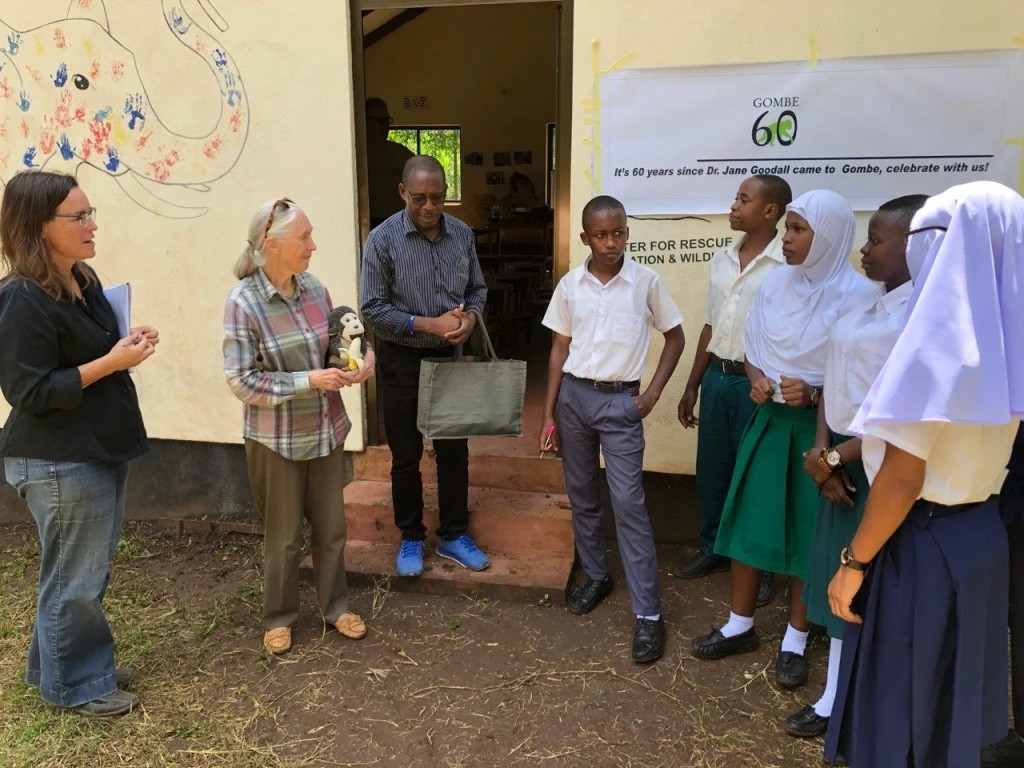
Her contribution to science and nature conservation has been recognized with dozens of awards, ranging from the Order of the British Empire to the highest international honors, including the Tyler Prize, UNESCO awards, and others. Over time, Goodall herself became a symbol. She proved that science can be not only a profession, but also a mission capable of changing the world.
You can read more about her journey in our article “The amazing life and work of Jane Goodall.”
A hero of the planet and a dear friend
“Today we have lost a true hero for the planet, an inspiration to millions, and a dear friend. Jane Goodall devoted her life to protecting our planet and giving a voice to the wild animals and the ecosystems they inhabit. Her groundbreaking research on Chimpanzees in Tanzania transformed our understanding of how our closest relatives live, socialize, and think—reminding us that we are deeply connected not only to Chimpanzees and the other great apes, but to all life,” actor Leonardo DiCaprio wrote on his social media.
According to him, for decades Goodall, with “tireless energy,” instilled hope, responsibility, and faith that every individual can change the world for the better.
“My last message to Jane was simple: “You are my hero.” Now, we all must carry the torch for her in protecting our one shared home.”
Like DiCaprio, she served as a UN Messenger of Peace. Both were outspoken advocates in the fight against climate change and for nature conservation. In May 2024, it was announced that they would act as executive producers of the film Howl, a story about a stray dog and a young wolf.
Goodall explained her participation simply:
“If people watch Howl and see that dogs and wolves can get on together and wolves aren’t terrible, vicious creatures, hopefully that gives them hope. If they believe there’s hope to stop trophy hunting wolves and killing them and poisoning them, they’re more likely to go on fighting and have hope their fighting might do some good.”
Jane Goodall had long believed that films “can change the way people perceive an animal that they didn’t know anything about before.” As an example, she often cited the documentary Forest People: The Chimpanzees of Gombe, filmed in Tanzania by the photographer and her first husband, Hugo van Lawick.
“After I’d been with the chimpanzees for two years, I was made to go to Cambridge [University]. I hadn’t been to college, and I was told I’d done everything wrong and that I shouldn’t talk about chimps having personalities, minds or emotions, I shouldn’t give them names and I should give them numbers,” Goodall recalled in an interview.
“It was my dog who taught me that that was all rubbish, and I just went on talking and writing about the chimps as they were, but it was when Hugo’s film came out and started going around that scientific attitude changed.”
A pivotal role in her life was played by anthropologist and archaeologist Louis Leakey, one of the most prominent researchers of early human evolution. He met Jane in Kenya in 1957 and later entrusted her with leading field research on chimpanzees in Tanzania, believing that a fresh perspective could lead to groundbreaking discoveries. It was also Leakey who invited photographer Hugo van Lawick to document this work.
Inspiring change
Craig Packer, one of the world’s leading experts on lion research, told Altezza Travel that he learned a great deal directly from Jane Goodall.
“Jane was an extraordinarily perceptive observer. I watched a troop of baboons at Gombe with her one day in 1972. I had been observing them for several months by then, and I had gotten to know them all as individuals. But Jane pointed out things that were happening between the different animals that I would never have noticed. She raised my level of understanding of the complexities of baboon life that I have relied upon ever since, whether studying primates or lions or casually watching other intelligent species like elephants. Her work had a similar effect on the entire field of Animal Behaviour,” Packer recalled.
“Jane Goodall was the first person to habituate a group of wild animals to her presence, and follow them daily for years, so that she was able to observe and describe the complex behavior and social lives of individuals in a way never done before.”
says Anne Pusey, one of her closest colleagues. For many years, Pusey has overseen the Gombe chimpanzee research archive, the educational programs based on it, and consultations for ongoing fieldwork.
“Her discoveries that chimpanzees made and used tools, had remarkably human-like communicative gestures, enduring family bonds, complex social relationships, and distinct personalities, rocked the scientific world and profoundly changed views of human uniqueness,” Pusey said.
Through this work, she added, Jane Goodall inspired other researchers to adopt her observational methods and helped pave the way for women in science.
The academic world of the 1960s was almost entirely male, says primatologist Sofia Dolotovskaya. At first, Goodall was viewed dismissively as someone who had “fallen from the sky rather than climbed the long academic career ladder.”
“But Louis Leakey calculated correctly. This allowed her to look at many seemingly obvious things without bias, Dolotovskaya notes. “Nonconformity held the key to her success. Goodall became one of the first scientists to approach animals not through rigid theories, but through love, kindness, and empathy.”
“Jane has often described the epiphany she had when she attended a conference on chimpanzees to celebrate the publication of her masterful scientific book, The Chimpanzees of Gombe, in 1986, and heard about the desperate plight of chimpanzees in other parts of Africa because of habitat destruction and the bushmeat trade. She was also shocked when she flew in a small plane over Gombe and observed the denuded hills all around the park,” Anne Pusey recalls.
It was after this moment that Jane Goodall began to say she felt obligated to use her fame and influence to help animals worldwide. She launched campaigns advocating humane treatment of primates in medical laboratories, supported sanctuaries for orphans affected by poaching, and helped establish conservation partnerships with local communities — first around Gombe, and later in other regions of Africa, including Uganda and Congo.
From Craig Packer’s recollections:
“I was having dinner at a High Table at a college in Oxford in 1990 when a Nobel Prize winner in medicine approached and asked me to please inform Jane that chimps would no longer be used as research animals by anyone in his field”.
Sofia Dolotovskaya calls Goodall a “superstar of the environmental movement.” Even those who are not interested in conservation or animal protection know her: “Jane Goodall approached the issue from a position of hope, not guilt. She did not say, ‘Look how bad everything is.’ She talked about how to make things better.”
“The kind of world that we cannot be too embarrassed to leave to our children”
Jane Goodall passed away in California on October 1. The following day, she was scheduled to speak to schoolchildren. The organizers chose not to cancel the meeting and instead showed the children a video message she had recorded shortly before the event:
"I think the ... key thing is to realize that every day on this planet, you make a difference, and if you start thinking about the consequences of the small choices you make – What you buy? Where did it come from? How was it made? Was there child slave labor [involved]? Did it help the environment? Would you eat it if it didn't involve cruelty to animals? – you start thinking like that, and millions of people around the world thinking like that, then we start to get the kind of world that we cannot be too embarrassed to leave to our children."
These were among the last words spoken by Jane Goodall.
All content on Altezza Travel is created with expert insights and thorough research, in line with our Editorial Policy.

Want to know more about Tanzania adventures?
Get in touch with our team! We've explored all the top destinations across Tanzania. Our Kilimanjaro-based adventure consultants are ready to share tips and help you plan your unforgettable journey.
 Climbing
  Safari
  About Tanzania
  Islands