





 52 reasons
  Free PDF


 Message us on WhatsApp
  Book a Free Call
Safari to Manyara Lake, Ngorongoro Crater & Serengeti Plains


This enriching five-day program offers you a unique opportunity to witness the transformation of Lake Manyara, which, depending on the season, can attract numerous colonies of pink flamingos. Despite its ever-changing nature, this place never fails to amaze with its natural beauty. You will witness the life of wild animals in the pristine Ngorongoro Crater and uncover the secrets of the vast Serengeti savannas. Throughout your journey, you will surely have the chance to encounter the iconic African Big Five (elephant, buffalo, leopard, rhinoceros, and lion), as well as giraffes, hippos, cheetahs, zebras, ostriches, jackals, mongooses, and many other species. Additionally, depending on the season, Tanzania might bless you with the unforgettable sight of the great wildebeest migration, as the herds move across the vast expanse of the Serengeti.

Tanzania parks are a haven for bird lovers, with hundreds of species to discover!

Ngorongoro Crater's walls create a natural enclosure where you can see more animals in one day than anywhere else on the planet
Is this tour for me?

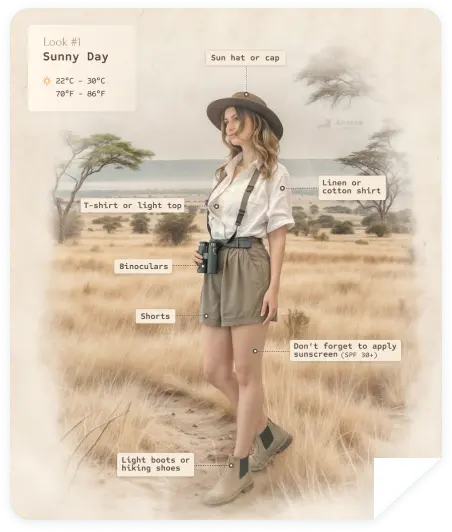
Safari Packing List

Safari Tour Seasons & Pricing
 Low Season
  Shoulder Season
  Peak Season
 Price per person (excluding international flights). Exact pricing is available upon request and depends on your travel dates.
Discounts are available for children under 16. Exact rates provided on request. During festive dates (Christmas, New Year or Easter), additional supplements may apply - your travel expert will confirm this when preparing your quote.
Low Season
Shoulder Season
Peak Season Price per person (excluding international flights). Exact pricing available upon request.
Discounts are available for children under 16. Exact rates provided on request. During festive dates (Christmas, New Year or Easter), additional supplements may apply - your travel expert will confirm this when preparing your quote.
Low Season
Shoulder Season
Peak Season Price per person (excluding international flights). Exact pricing available upon request.
Discounts are available for children under 16. Exact rates provided on request. During festive dates (Christmas, New Year or Easter), additional supplements may apply - your travel expert will confirm this when preparing your quote.
Rainfall is frequent, transforming parks into lush green landscapes. Very few travelers visit, so wildlife feels almost undisturbed. Perfect for enjoying private safari moments and discounted hotel rates.


Mostly dry with occasional rains, keeping the parks vibrant. Jan-Feb and early Dec see occasional showers, while March and June tend to be more stable. A great time with fewer travelers, relaxed pace and frequent wildlife encounters.


Dry conditions reveal the savanna’s full beauty, making game drives easy and wildlife visible. Expect lively safari experiences and spectacular predator sightings, though you’ll notice more travelers than in other months.


Itinerary
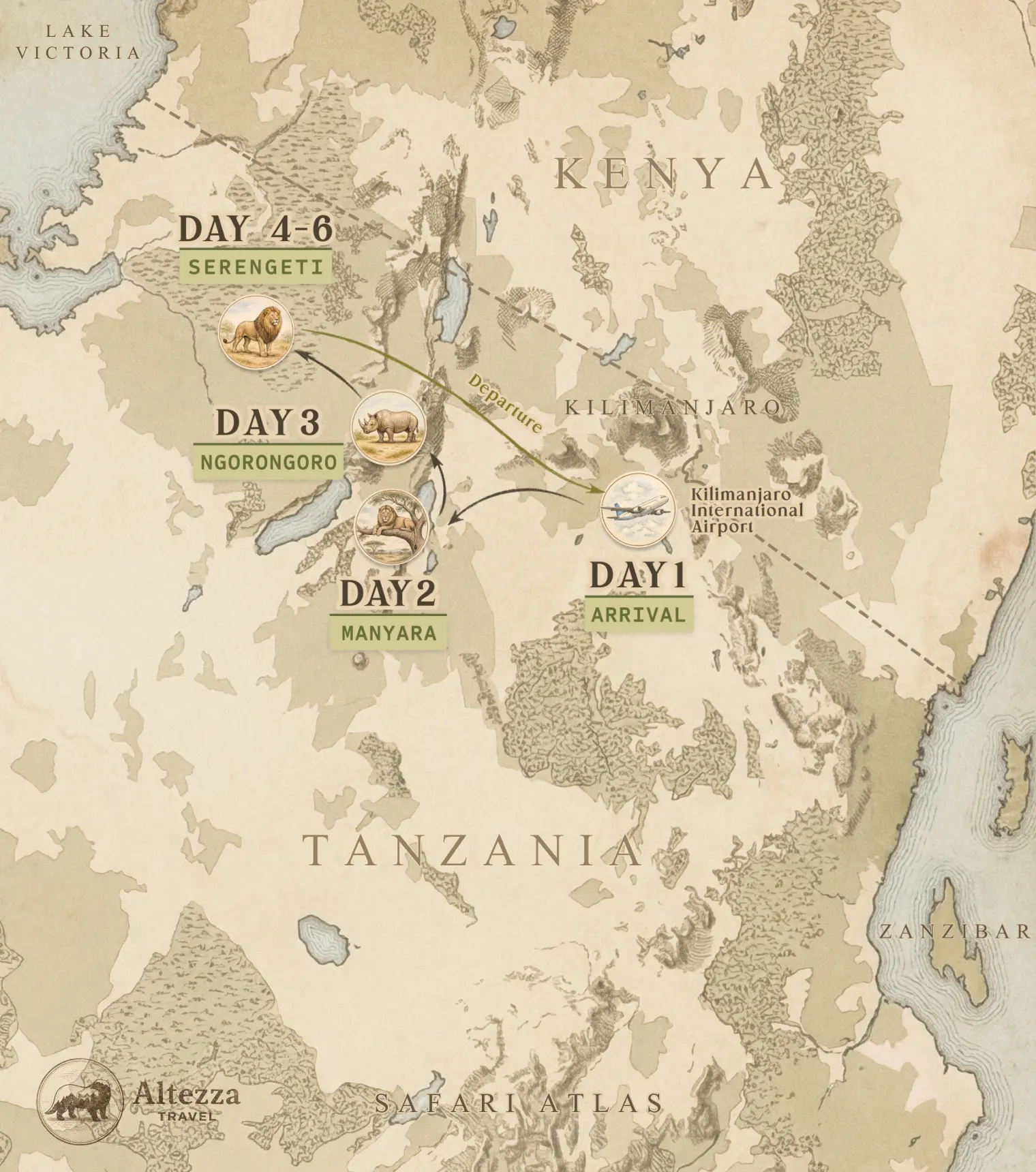
The group arrives at Kilimanjaro Airport (JRO). Participants are met by a representative of Altezza Travel and transferred to a hotel in Arusha.
Note: Check-in starts at 2:00 PM.

 Meal Plan:
Half Board
Meal Plan:
Half Board  Explorer
  Signature
  Premium
Explorer
Premium
Explorer  Signature
  Premium

Today you will travel to Lake Manyara National Park. This is where pink flamingos from all over Africa flock. At times, there are hundreds of thousands covering the shores of Lake Manyara, making it appear pink from a distance. Up close, you can see the individual birds along the lakefront of this amazing area. Your guide will share more about these beautiful birds. Flamingos on Lake Manyara are found between the months of April and November.
You will not likely see them in other months of the year. Even so, their presence is not guaranteed, as weather, predators of unpredictable rainfall can impact their movement. In addition to pink flamingos, Lake Manyara is home to over 400 species of other birds. This is one of the best places in all of Tanzania to enjoy watching birds, as you can see a vast quantity and variety in the forests around the lake. In addition to birds, you will surely see giraffes, elephants, warthogs, antelopes, zebras and other African wildlife. The lions on Lake Manyara are very unique; they love to climb trees! Making them the ‘tree-climbing lions’; in other locations you can find lions sleeping in the shade or prowling in tall grass, but in Manyara National Park you will likely be looking up into tree branches to spot them.
Meal Plan:
Full board
Explorer  Signature
  Premium

Today you are heading to the legendary Ngorongoro Crater. We recommend starting the drive early, usually around 6:30–7:00 AM, depending on your lodge location. This allows you to enjoy the crater in the quieter morning hours before larger crowds arrive. The descent from the rim to the crater floor takes about 30 minutes, passing along the forested crater wall, while the spectacular panorama of the caldera gradually opens up below.
The crater formed about 2 million years ago when a massive volcano collapsed after a powerful eruption, creating one of the world’s largest intact volcanic calderas. Inside this ancient volcanic crater lives an extraordinary concentration of wildlife – one of the highest densities of animals anywhere in Africa.
Elephants, buffaloes, antelopes, lions, cheetahs, and zebras are commonly seen here, and the crater is also one of the few places where you might spot the endangered black rhino. Although animals can leave the caldera, most remain thanks to the abundant grasslands and reliable water sources. One animal you will not see here is the giraffe – their body structure makes it difficult for them to descend the steep crater walls. The crater forms part of the Ngorongoro Conservation Area, recognized as a UNESCO World Heritage Site for its exceptional wildlife density and unique volcanic landscape.
For lunch, your guide will take you to a scenic picnic area near a Hippo Pool. This spot is popular with many birds, including kites that sometimes try to snatch food from the table, so it’s best not to leave meals unattended. The lake is also home to hippos, which often rest near the shore and surface regularly, offering great chances to observe them while you eat.
Please remember not to feed any animals in Ngorongoro or other parks in Tanzania. Human food can seriously harm wildlife and disrupt their natural diet. This is also strictly prohibited by park regulations, and anyone caught feeding animals may face a fine.
Meal Plan:
Full board
Explorer
Signature
Premium
Explorer  Signature
  Premium

Today’s adventure takes you to the world-famous Serengeti, in the stunning Seronera area. The park is home to over 3 million animals and stretches across an area so vast it would take 2-3 days to cross by car, giving wildlife plenty of space to roam freely. Here, you’re almost guaranteed to see lions, antelopes, elephants, giraffes, buffaloes, and zebras, with a good chance of spotting cheetahs, serval cats, and other rare savannah animals. The Serengeti is a UNESCO World Heritage Site, celebrated for its unique ecosystem, dense wildlife, and the annual Great Migration. Life here inspired Disney’s Lion King, but unlike a cartoon, it’s raw, wild, and breathtaking.
Meal Plan:
Full board
Explorer
Signature
Premium
Explorer
Signature
Premium 
Your adventure continues in the vibrant central Serengeti area. This vast landscape teems with wildlife, and it is impossible to view it all in one day. Today, your guide will lead you to new spots and highlight fascinating animals, giving you a broader view of the Serengeti’s richness. Seronera is home to some of Africa’s rarest species, including rhinos, leopards, serval cats, and caracals. Sometimes it can take several hours to spot a rare animal, but with a full day ahead, you’ll have plenty of opportunities to focus on the creatures you most want to find.
Meal Plan:
Full board
Explorer
Signature
Premium
Explorer
Signature
Premium 
Time in сentral Serengeti is always full of surprises. Every day in the savannah brings something new – you’re unlikely to see the same scenes twice. Lions that seemed lazy yesterday may be active today, elephants that walked away before might come closer out of curiosity, and you never know what unexpected wildlife moment awaits.
This is also a great opportunity to explore the famous kopjes – ancient volcanic rock formations that shape the beautiful Seronera landscape. Many animals like to rest in their shade, which creates wonderful photographic opportunities.
You may also visit Simba Rock. It resembles the iconic scene from The Lion King, where Mufasa presents baby Simba to the savannah. Seeing this setting in real life adds a fun and memorable touch to your Serengeti experience!
Meal Plan:
Half Board
Explorer
Signature
Premium
Explorer
Signature
Premium Rest in the hotel and transfer to the airport.
Note: Hotel check-out is at 10:00 AM. In case you need a late check-out before your evening flight, you have the option to extend your hotel stay for an extra fee. Let your manager know in advance if you need a late check-out.
Inclusions
Do you need a visa to visit Tanzania?

See how your trip uplifts communities


Reviews about Safaris with Altezza


For our honeymoon we wanted to plan a truly memorable and personalised trip. Sophie helped us to plan our 7 day safari visiting Arusha, Tarangire, Ngorongoro, Serengeti national parks.
Our guide, Noel, was the perfect guide! - Kind, polite, knowledgeable and patient. We were able to see the big 5 as well as so many other animals. Thank you Noel for making our trip so special.
I would recommend Altezza for anyone looking for a truly special safari holiday.


I haven’t stopped talking about this trip + Altezza since we got home!! We decided to go on Safari for our honeymoon and didn’t even know where to start! Altezza was recommend to us and we never looked back. Before, during and after the trip they made sure we were taken care of + went above and beyond to make it the trip of a lifetime.
They answered all of our pre-trip questions and ensured we were set. During the trip, they added personalized touches (including a customized tire cover!!) and our guide Noel was better than we could have ever imagined.
Tanzania is a special place, the people are the kindest you will ever meet and Altezza is doing an absolutely incredible job. If you are thinking of going on safari, DO IT and if you are thinking of using Altezza, DO IT! We can’t wait to go back!


Altezza Travel organized our 5-day Safari plus 10-day family vacation in Northern Tanzania. We left Tanzania with an overall amazing experience and one thing on our minds: going back as soon as possible!
The Safari guide was kind, knowledgeable, ressourceful, and did everything to make our experience unforgettable . People at the different places we stayed had a warm welcome and didn't spare energy to provide us the best accommodation ever. The transfer team was also dedicated and professional.
From my own positive experience, I recommend Altezza Travel to people planning Safari vacation in Tanzania.
 Read Reviews