





 52 reasons
  Free PDF


 Message us on WhatsApp
  Book a Free Call

 About Tanzania
In April, an Ebola outbreak occurred in Ituri Province in the Democratic Republic of the Congo (DRC). The virus was also diagnosed in two people in Kampala, the capital of Uganda, although both patients had recently arrived from the DRC. On May 17, the World Health Organization (WHO) declared the situation a Public Health Emergency of International Concern. At the same time, the organization emphasized that this is not a pandemic and that the situation requires monitoring rather than border closures. Here is why traveling to Tanzania remains safe.
Outbreak of a rare Ebola strain: timeline of events
- April 24. A patient with a high fever, bleeding, and vomiting was admitted to a hospital in Bunia, located in Ituri Province, a remote region in northeastern DRC. The patient was a local healthcare worker believed to be the first infected person. It quickly became clear that this was not an isolated case, as more patients with similar symptoms began arriving at hospitals.
- May 5. The WHO received reports of an outbreak of an unidentified disease with a high fatality rate in the affected region. Initial Ebola tests returned negative results at that stage. A team of experts was immediately dispatched to the DRC.
- May 14–15. Expanded laboratory testing identified the Bundibugyo virus, a rarer strain of Ebola. This explains why the initial tests were negative. By that time, the number of suspected cases in the DRC had nearly reached 250, while two additional cases were confirmed in Kampala, Uganda. Both patients had recently traveled from the DRC.
- May 15–17. The Ministry of Health of the DRC officially declared the country’s 17th Ebola outbreak in history. The World Health Organization classified the situation as a public health emergency of international concern.
Traveling to Tanzania is safe
According to the WHO’s official statement, despite the seriousness of the outbreak, this is not a pandemic, and there is no recommendation for any country to close its borders. The recommended measures include enhanced surveillance, preventive measures, and contact tracing. Importantly, no Ebola cases have been detected outside the DRC and Uganda. Here is why there is no reason for panic.
How the Bundibugyo virus spreads
This is indeed a rare and dangerous strain of Ebola because there are currently no approved vaccines or specifically developed treatments for it. However, according to the WHO, early detection and supportive care significantly improve survival rates.
The key point is that this disease is not transmitted through the air like Covid-19. The Bundibugyo virus spreads only through direct contact with the bodily fluids of an infected person, including blood, vomit, and other secretions. In other words, infection can occur only while caring for a sick person or through contact with contaminated medical instruments.
During a trip to Tanzania, whether on safari, climbing Kilimanjaro, or relaxing in Zanzibar, tourists are not exposed to these transmission chains. The absence of danger for travelers to Tanzania is also reflected in guidance from the U.S. Department of State. On May 17, amid the Ebola outbreak, the department raised travel advisories for the DRC and Uganda to the highest level. No similar changes were made for Tanzania.
Distance from the outbreak epicenter
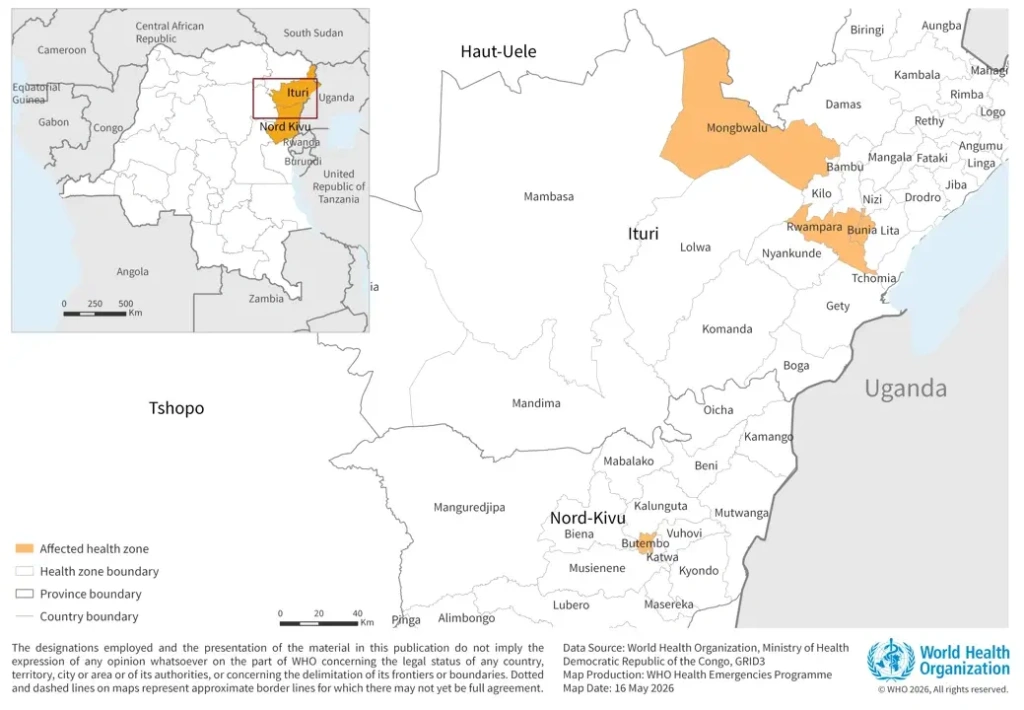
Ituri Province, where the Ebola outbreak occurred, is located in northeastern DRC near the Ugandan border. This is far from Tanzania and even farther from the country’s main tourist regions.
For example, the cities of Arusha and Moshi are considered the main starting points for travelers heading to Mount Kilimanjaro or on safari to Serengeti, Ngorongoro, and other national parks. The distance from these cities to Bunia in Ituri Province is approximately 1,300–1,400 km (810–870 mi), while Kampala in Uganda is around 900–1,000 km (560–620 mi) away. This is comparable to the distance between New York and Chicago. Zanzibar and Dar es Salaam, Tanzania’s largest city, are even farther away.
Previous Ebola outbreaks in Uganda and the DRC
As mentioned earlier, this is not at all the first Ebola outbreak, including outbreaks of the Bundibugyo strain, in these countries.
In Uganda, outbreaks of a similar or even larger scale occurred in 2000, 2007, 2011, 2012 (twice), 2019, 2022–2023, and 2025. In the Democratic Republic of the Congo, outbreaks were recorded in 1976, 1977, 1995, 2007, 2008–2009, 2012, 2014, 2017, 2018 (twice), 2020, 2021 (twice), 2022 (twice), and 2025.
Not a single one of these outbreaks over the past 50 years has reached Tanzania. Nevertheless, the country’s authorities have taken precautionary measures. According to Erasto Sylvanus, Director of Emergency Preparedness and Response at the Ministry of Health, the Tanzanian government is working closely with the WHO and neighboring countries. Surveillance and health screenings at the borders with the DRC and Uganda have been strengthened; expert teams have been deployed to potentially high-risk areas; hospitals across the country have been placed on high alert; and monitoring of patients with relevant symptoms has been intensified.
How Altezza Travel is operating under the current conditions
The company continues to operate normally. Our team based in Moshi is monitoring the situation in real time through official channels. At present, there are no reasons to change itineraries or postpone tours.
If the situation changes, we will inform our clients immediately, before they even hear about it in the news.
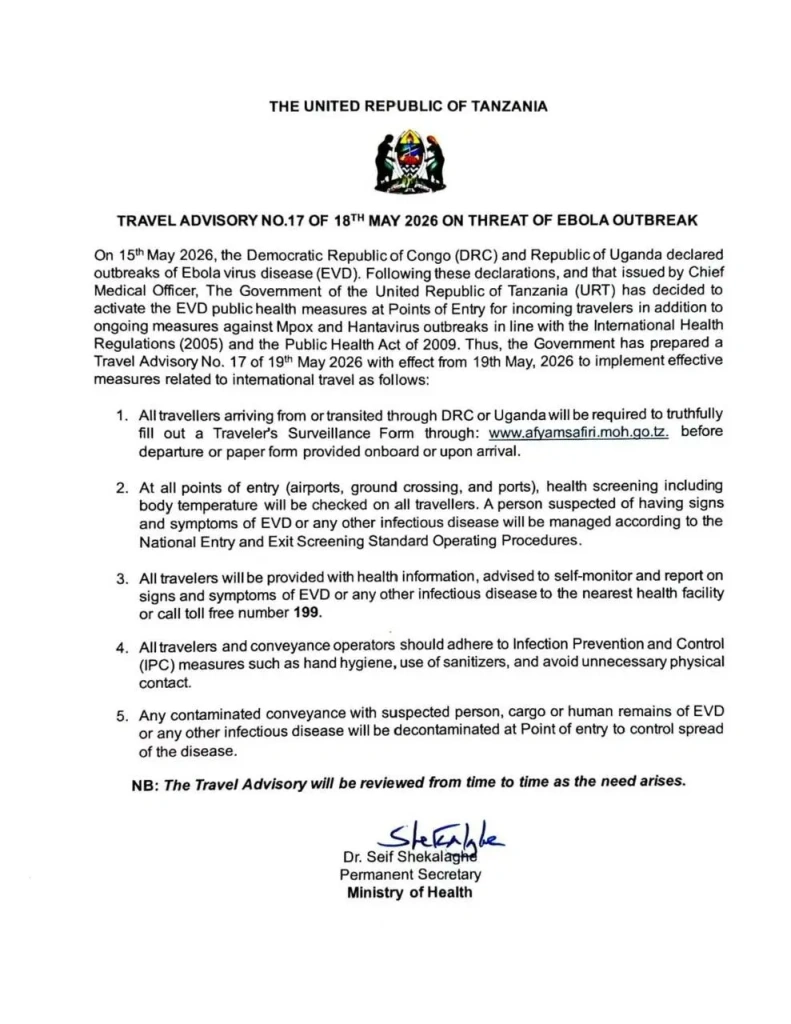
Updated May 20: Tanzanian authorities have introduced additional safety measures at all border entry points:
- All travelers arriving from the Democratic Republic of the Congo (DRC) and Uganda, or those who have transited through these countries, are now required to truthfully complete a Traveler’s Surveillance Form. This can be done in advance at www.afyamsafiri.moh.go.tz or upon arrival using a paper form.
- At all points of entry into the country, including airports, land border crossings, and ports, travelers will undergo health screening, including temperature checks. Anyone suspected of showing signs or symptoms of Ebola or another infectious disease will be managed in accordance with Tanzania’s national screening procedures.
- Any vehicle, cargo, or human remains suspected of contamination with Ebola or another infectious disease will be decontaminated at the point of entry.
- Travelers and transport operators are advised to follow infection prevention and control measures, including hand hygiene, the use of sanitizers, and avoiding unnecessary physical contact.
- Travelers will also receive health information and are advised to monitor themselves for symptoms of Ebola or other infectious diseases and report to the nearest health facility or call the toll-free number 199 if symptoms appear.
Below is the official document published by the Tanzanian government:
All content on Altezza Travel is created with expert insights and thorough research, in line with our Editorial Policy.

Want to know more about Tanzania adventures?
Get in touch with our team! We've explored all the top destinations across Tanzania. Our Kilimanjaro-based adventure consultants are ready to share tips and help you plan your unforgettable journey.