





 52 reasons
 Free PDF


 Message us on WhatsApp
 Book a Free Call


Nyungwe National Park
Nyungwe National Park is a vast tropical rainforest covering the mountains of southwestern Rwanda. Visitors come to trek with chimpanzees, see black-and-white colobus monkeys, go birdwatching and walk across a canopy bridge above the treetops. It is one of the oldest ecosystems on the continent and home to plants and animals found nowhere else on Earth.
What makes Nyungwe unique?
Rwanda is often called the “Land of a Thousand Hills” because green mountain slopes cover much of the country. Nyungwe lives up to the name: its rainforest covers about 1,020 km² (394 sq mi), at elevations ranging from 1,480 to 2,950 m (4,860 to 9,680 ft). It is the largest tropical forest in Rwanda and one of the oldest on the continent. Scientists estimate that it has survived since the last Ice Age, more than 20,000 years ago.
A visit to Nyungwe is a highlight of any Rwanda safari. The park is home to 1,468 plant species, more than 90 mammal species, 13 primate species and around 320 bird species. Many are endangered or endemic, meaning they are found nowhere else in the world. Nyungwe is also the source of streams that feed two of Africa’s great rivers, the Nile and the Congo. In 2023, UNESCO designated Nyungwe National Park a World Heritage Site, calling it “one of Africa’s most biologically important and diverse forests.”
Where is Nyungwe located?
Nyungwe National Park lies in southwestern Rwanda, right along the borders with Burundi and the Democratic Republic of the Congo. International journeys through Rwanda typically begin in Kigali, the capital and the country’s main international gateway. From Kigali, Nyungwe is about 225 km (140 mi) away, a drive of roughly five to six hours. The journey is scenic, passing through rolling hills and tea plantations.
There is a faster option: a 40-minute flight from Kigali to Kamembe, followed by a roughly 1 to 1.5-hour drive to the park.
When is the best time to visit Nyungwe?
Rather than four distinct seasons, Rwanda has alternating dry and rainy periods. Each has its own advantages and drawbacks, but the weather does not prevent wildlife viewing: chimpanzee and colobus trekking, other primate excursions, and birdwatching are available year-round.
Dry seasons
There are two dry seasons: the short dry season from December to February and the long dry season from June to September. Rainfall is significantly lower during these months, leaving forest trails drier and firmer and making trekking and rainforest walks much easier. The mountain slopes and canopy bridge also offer sweeping panoramic views.
These conditions attract many travelers, so it is best to book trekking permits and lodge stays at least several months in advance.
Rainy seasons
There are also two rainy seasons: the long rains from March to May and the short rains from October to November. Rainfall is much heavier during these periods, making trails slippery and uphill sections more demanding. On the other hand, there are fewer visitors, the scenery is greener and more vivid, and tour operators and lodges often offer discounts.
Rain usually falls in the afternoon, while trekking starts early in the morning. In rare cases, however, schedules may change because of severe weather, such as a strong thunderstorm.
It is worth keeping in mind that Rwanda’s seasons are not absolute: rain in January or August is perfectly normal, just as sunny days in April are.
Things to do in Nyungwe National Park
Nyungwe is home to more than 90 species of mammals, including forest antelopes such as duikers, as well as mongooses, and servals – small wild cats. However, spotting these animals is rare, and visitors are more likely to find evidence of them in the form of tracks. For travelers, Nyungwe is primarily a forest of monkeys and birds, with scenic mountain trails and sweeping panoramic views.
Chimpanzee trekking
This is the main reason travelers come to Nyungwe from around the world. Chimpanzees are our closest living relatives, sharing 98% of their DNA with humans. Only a handful of places in Africa offer the chance to see them in the wild, and Nyungwe is one of them. The park is home to the eastern chimpanzee, a subspecies that the International Union for Conservation of Nature classifies as Endangered.

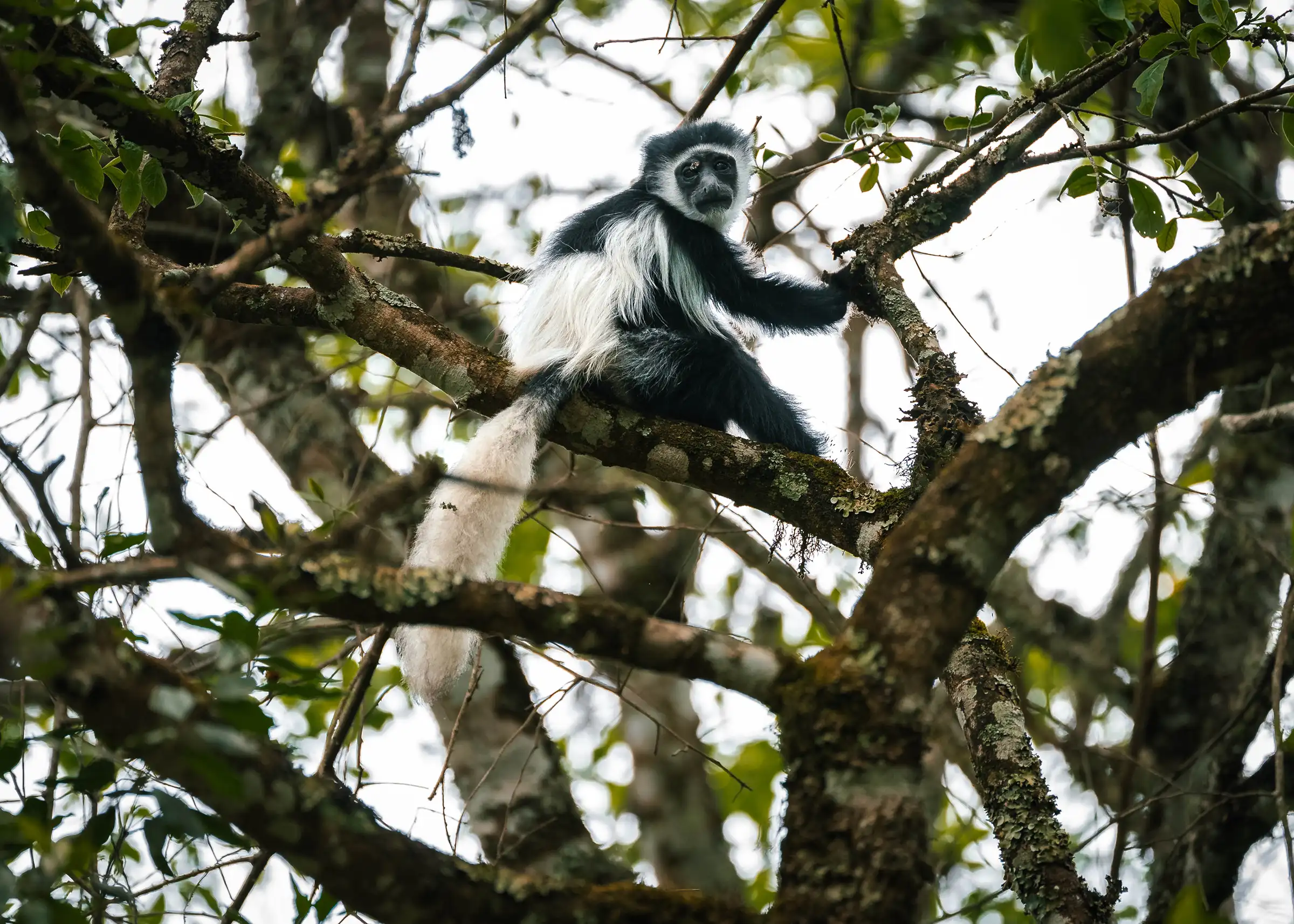
Colobus and other primate trekking
The park is home to 13 primate species, two of which are found only in this region: L’Hoest’s monkey and Hamlyn’s monkey. Grey-cheeked mangabeys, blue monkeys and red-tailed monkeys are also frequently seen along the trails, while olive baboons can be spotted around the edges of the tea plantations.
These trips are shorter and easier than chimpanzee trekking, so they have no age restrictions and can easily be combined with other activities in the park. A permit for international visitors costs $40.
Birding
Nyungwe is considered one of Africa's best birding destinations. More than 320 species live here, around 30 of which are found only in the mountains of this region.
The best time to go birdwatching is early in the morning, preferably with a birding guide. An experienced guide can identify birds by their calls and knows where to look for rare species. There are no age restrictions, and guided excursions cost $40 for international visitors.
Canopy bridge over the ancient forest
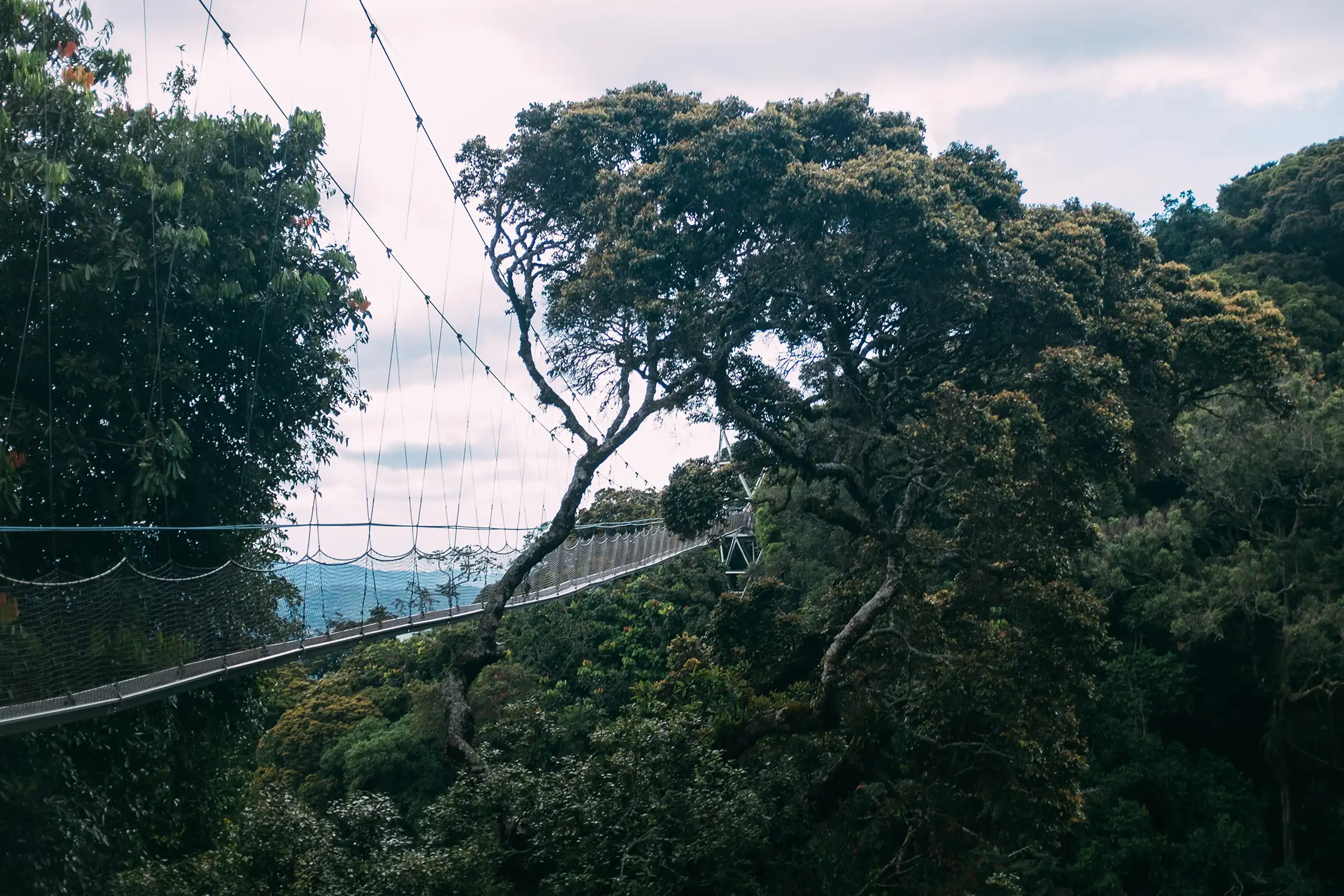
This is Nyungwe’s best-known walk and a rare opportunity to see a tropical rainforest from above the treetops. The suspension bridge spans a valley, offering panoramic views over the ancient forest and surrounding hills.
The walk is short and easy, so you don't need to set aside a full day, and it pairs well with other activities in the park. The bridge itself is safe, although it sways slightly underfoot. There are no age restrictions. International visitors pay $40.
Hiking trails and waterfalls
Nyungwe has an estimated 130+ km (81+ mi) of trails, ranging from short two-hour walks to multi-day hikes with overnight stays in forest cabins. Some routes lead to waterfalls, while others climb to viewpoints overlooking the surrounding hills. The park also has a zipline almost 2 km (1.2 mi) long, suspended above the forest. It is divided into three sections, each offering a different perspective of Nyungwe from above.
Regular forest walks are included in the park entrance fee. Guides are available for an additional fee, depending on the length of the route. The zipline costs $100 for international visitors.
Frequently asked questions
What is unique about Nyungwe National Park?
Nyungwe is one of Africa’s oldest rainforests. It dates back tens of thousands of years and survived the last Ice Age, allowing an extraordinary variety of rare plants and animals to persist here. Today, the park is home to 13 primate species, more than 90 mammal species, more than 320 bird species and around 1,500 plant species. It is a UNESCO World Heritage Site.
How much does it cost to visit Nyungwe National Park?
The total cost includes the park entrance fee, plus separate fees for individual activities. For international visitors, the entrance fee is $100 and covers access to the forest trails, including routes to the waterfalls, without a guide. Other activities are charged separately: chimpanzee trekking costs $150, trekking to see colobus monkeys and other primates costs $40, and the canopy walkway costs $40. Reduced rates are available for children, as well as residents and citizens of African countries.
What is chimpanzee trekking like in Nyungwe?
Visitors meet at the visitor center early in the morning. After a short briefing, they set out with a ranger/guide to search for chimpanzees. Finding them can take several hours. Groups are limited to eight people. Once the chimpanzees are located, visitors can spend one hour observing them.
How long and high is the Nyungwe canopy walk?
The Nyungwe canopy bridge is about 160 m (525 ft) long and 70 m (230 ft) above the ground. It offers views over the ancient forest and densely forested hills.
Subscribe Altezza Travel on YouTube


Stay in touch on Instagram


Altezza Travel Ranked #1 on TripAdvisor


I was impressed by Altezza even before I arrived, as having an agent to help with planning who was in a similar time-zone made a huge difference. And the quality of this company was apparent as soon as I landed in Tanzania. All of their hotel and lodge recommendations were excellent as well (reviewed separately). Lots of online follow up and support.
However, I knew they were the best when I got in their identical to those from other companies, Altezza vehicles are very different inside. They are the sole company which has only 4 seats, while all the others have 6 seats (and much less leg room for this reason). This made a giant difference to our experience, as we were often in the Land Cruiser for 8 hours or more on various safari expeditions. Being able to stretch, lean the seat back, and have our bags transported, made a huge difference. Yes, it makes the transportation a bit more expensive, but absolutely worth every penny. I looked at multiple other vehicles while traveling, and none of them had only 4 seats. Kudos to Altezza.
The second reason I rapidly became aware of how excellent they are is when we met Daniel, our guide/driver. Firstly, not only was his English outstanding, and secondly his knowledge was exceptional (he had a degree in wildlife management), but on top of this he is also an outstanding wildlife photographer who has published a book of photos. He was with us every step of our 6-day safari and enhanced it in every way possible. This included sharing with us the photos he took with us (far superior to ours), which has really elevated our memories of this trip and provided photographs that we can share with others (some examples of his photos are attached).
In conclusion, there are multiple reasons why Altezza is the best company to go on Safari with, but I suggest that if you are going for 4-days or more you also try and ask for Daniel specifically for an even more amazing experience.


I had a fantastic experience booking a 10 day vacation in Tanzania with Altezza, which included 6 days of Safari + 3 days in Zanzibar. Everybody from Altezza I interacted with was very helpful and professional. The travel manager (Aiman) was very responsive helpful to book my custom itinerary. During the actual trip, another travel manager (Victoria) stepped in, and she was also extremely helpful and responsive. My whole stay in Tanzania was stress free, as Altezza handled all the hotel bookings, flights from the Tanzania mainland to Zanzibar, airport transfers and the safari itself.
The safari was an unforgettable experience. Seeing so much wildlife in their natural habitat was truly awesome. Special shout out to our driver/guide, Paschal, who is an expert driver and extremely knowledgeable about the Tanzanian fauna and flora. It was a pleasure having him as our safari guide. Also, Altezza’s car was kept in excellent condition (cleaned inside and out every day, even in the middle of the savannah). For small groups (up to 4 people), Altezza’s cars have an advantage over most of the other safari cars I saw in my trip: they’re all the same size, but Altezza’s car has 4 seats while all of the other cars I saw had 6, so we had more legroom. Nice!
All in all, I highly recommend Altezza for a safari trip in Tanzania!
 Read Reviews